In the summer of 2020, the Pacific Crest Trail was open and the country was not. Public land across the West sat under emergency orders: national parks, state parks, county parks, even some national forest campgrounds. The orders had been written by people who had likely never slept on the ground in their lives, and likely never would. The trail itself, a stripe of dirt running 2,650 miles from Mexico to Canada, was technically still walkable. The places where a hiker could legally lie down at the end of a day were not.
I walked about 850 miles of it that year. I want to tell you about two nights.
Day One: Lake Morena
The first day on trail is twenty miles from Campo, California, to Lake Morena County Park. It ends in a climb and a descent that earn the camp by the time you arrive. When I finally walked into the campground, one other hiker was already there, her tent set up in a designated site. I pitched mine a careful fifty yards from hers, used the showers, which are a real luxury at mile twenty, and walked back to my tent to find a park ranger standing next to it.
He was polite. He did not appear to enjoy what he had to say. He told me I could not stay. COVID restrictions. The campground was closed. He suggested I get back on the trail and find a secluded spot off-trail somewhere down the line.
It was almost dark. There were two of us in the entire campground, set fifty yards apart, in the open air of a Southern California spring evening. An emergency order required that we both be removed from a place designed to hold a great many more of us than that. I packed up. I walked another two miles. I pitched my tent on the trail itself, because there was nowhere else to pitch it. I slept fine. The trail, it turns out, is dirt. You can put a tent on it. The pandemic was no closer to me there than it had been in the campground. The only thing that had changed was the paperwork.
Mile 342: A Side of Pizza
A few hundred miles later I came into Silverwood Lake Campground with a small group of hikers I had been leapfrogging since the desert. We had been looking forward to this stop for days. Pizza was the reason. You could order pizza delivered to Silverwood. A guy in a car would drive it out to a picnic area in the woods, you would pay him in cash you had been carrying since the last town, and you would sit at a wooden table and eat hot pizza in a place you had walked to.
We pitched our tents far apart from one another. We regrouped under the picnic shelter. The pizza arrived. The driver did not appear to be carrying a clipboard from the Department of Public Health. He handed over the boxes and drove away. I will remember the pizza for the rest of my life.
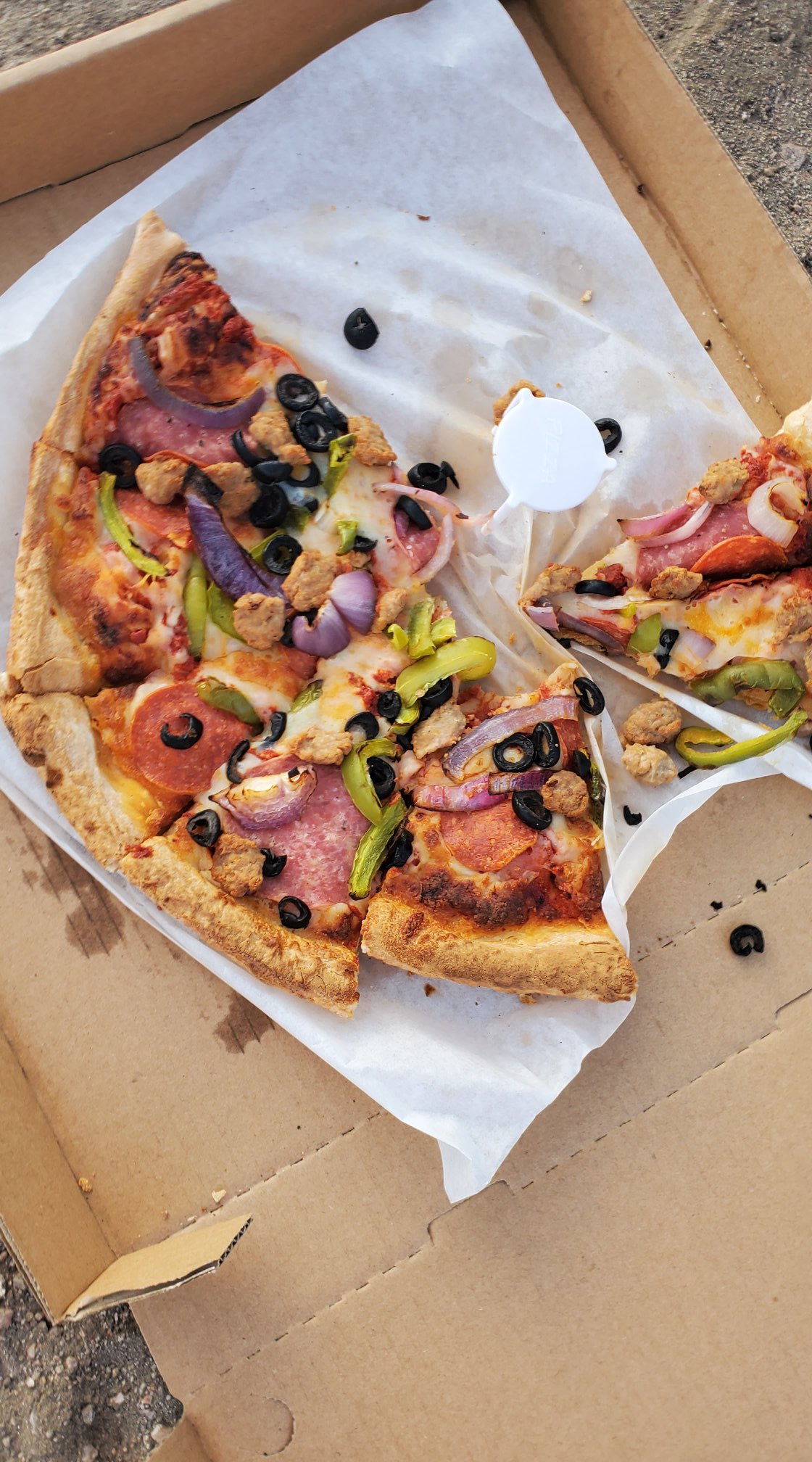
We were eating it when a local police officer came in. He was kind. He stayed and talked with us for thirty minutes about the trail and the area before he got to what he had come to say. Then he told us we could not stay there that night. COVID restrictions.
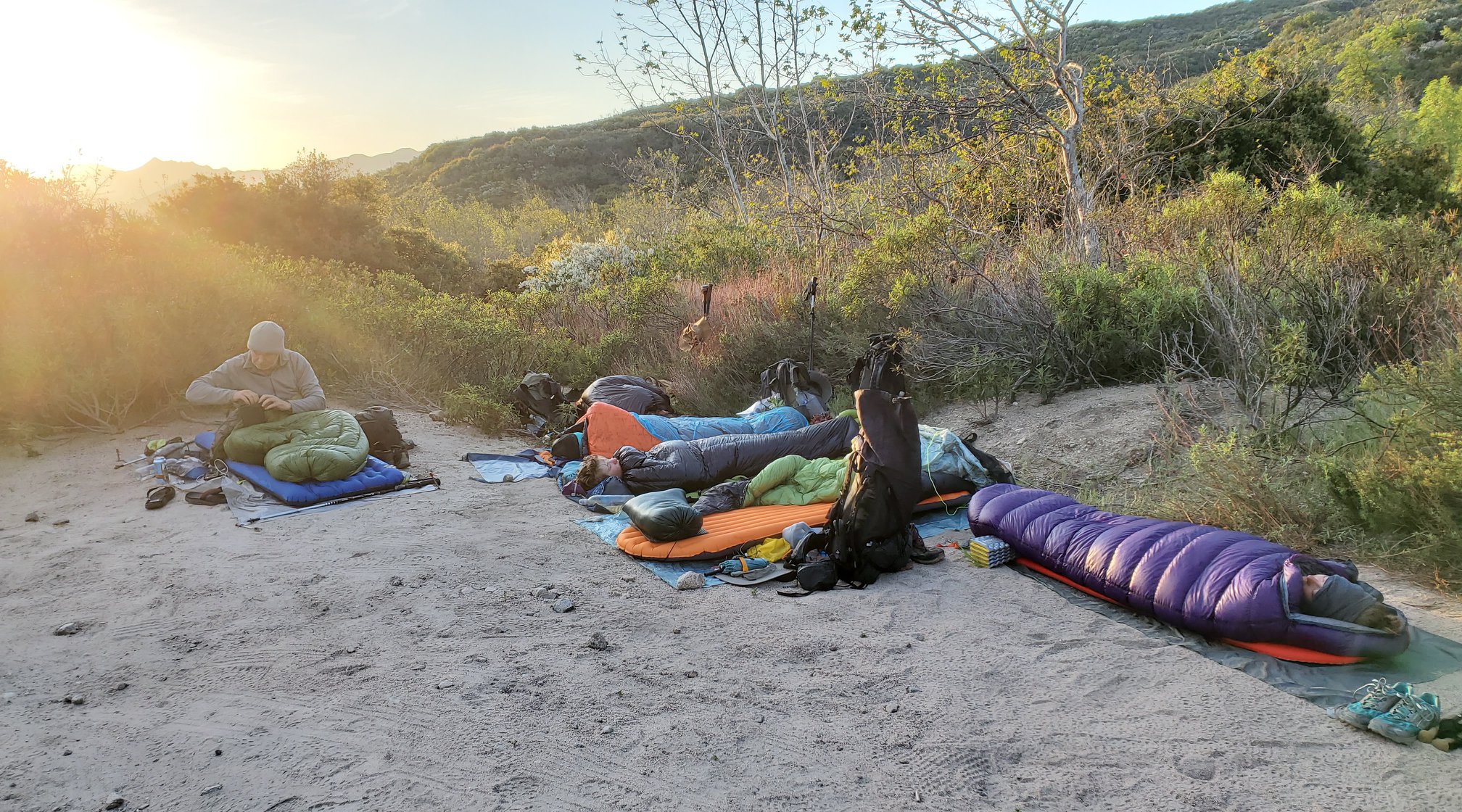
By then it was dark. We pointed out that there was nowhere else to pitch a tent. We had walked all day, the campground was empty, the picnic area was empty, and we were already as spread out as a group of friends can reasonably be. He shrugged. He thought we might find a place to put a sleeping bag down about half a mile up the dirt road.
So we packed everything back up. We carried our leftover pizza and our tents and our overstuffed packs into the dark, walking single file along a dirt road as two trucks whipped past us in the night. There was nowhere to pitch a tent. There was barely anywhere to lie down. We unrolled our sleeping bags on the edge of the road, packed in tightly together, because when you have just spent an evening being told to spread out for a virus, the immediate threat at midnight is no longer the virus. It is the pickup truck that might not see you. We slept. We did not get run over. In the morning, we were quietly grateful for it, and we walked on.
What the Rules Were Actually Doing
What I have thought about, again and again, in the years since, is what the rule was actually doing. Not what it was meant to do — what it was doing.
In both cases, there was no public health to protect. The Lake Morena campground held two people fifty yards apart in the open air. The Silverwood campground held seven people sitting outdoors at picnic tables eating pizza delivered by a man who drove off without comment. We were in the safest place we could possibly have been during any airborne illness the bureaucracy claimed to be fighting. We were turned out into the road anyway, because the rule was not engineered for the situation in front of it. It had been engineered in a conference room hundreds of miles away, by people whose job was to issue a rule that applied uniformly to everyone, without exception for the case where the rule made things actively less safe.
This is what happens to land when its use is governed by statute. The statute doesn't have to be wise. It doesn't have to fit the circumstance in front of it. It doesn't even have to be enforced by people who think it makes any sense; the ranger at Lake Morena and the officer at Silverwood were not the architects of what they were enforcing. They were sympathetic. They were doing their jobs. The system above them had decided that the campgrounds were closed, and so the campgrounds were closed, and so we slept on a dirt road.
That is the fragility hiding inside the words public land. The land itself is durable. The land does not care about an emergency order. The land was perfectly capable of holding our seven tents and our pizza and our quiet evening. What is fragile is the permission to use it. And permission, unlike land, can be revoked by a press release.
The Quieter Constant of Private Land
Here is what I have come to believe matters most about that summer.
Private land does not close because a county press release goes out. A landowner who has agreed to welcome someone has agreed to welcome them, and no statute can unsay that agreement without crossing a much harder line than a press release. A guest who has been invited has been invited. A campfire on someone's own forty acres is not at the mercy of a bureaucrat's mood. The arrangement is between two people who looked each other in the eye and agreed to it.
This is not a small thing. In 2020, while public campgrounds across nearly the entire country were posting closed signs at their gates, the private land beside them was still working exactly as it had worked the year before. Family was still welcome. Friends were still welcome. A traveler with a friend-of-a-friend connection was still welcome, sometimes after a five-minute phone call. The land was unchanged. The rules over the land were unchanged. The people who owned the land had made up their own minds, and what they had made up their minds about was the same thing they had made it up about the day before, and the year before, and the decade before.
The reason that mattered is not that landowners are wiser than bureaucrats. It is that they are answerable to a much narrower set of considerations, all of which are immediate and human: who is this wo/man, do I trust them, is the place ready for them, did we agree on the terms. None of those questions can be answered by an emergency order written in a conference room. All of them can be answered by two adults having a conversation.
And Then the Platforms Did It Too
One caveat is important here. Not every landowner I knew in 2020 still had control of their own land that summer, because not every landowner had reserved that control for themselves. The ones who had listed their property on a corporate platform like Airbnb or Hipcamp found out that the platform's terms of service were not, in practice, separate from the bureaucracy's emergency orders. They were an extension of them.
When state and county governments issued shelter-in-place mandates and travel restrictions, both Airbnb and Hipcamp moved to enact platform-wide policies that lined up with those mandates. Forced cancellations. Restricted bookings. Mass refunds initiated without host approval. In many cases, listings were made unbookable for weeks or months at a time. The hosts had not agreed to any of that when they joined. They had agreed to a marketplace. The marketplace, when the time came, became a compliance mechanism. And the compliance applied to private land that the platforms did not own, but did, by then, effectively control.
Whether those decisions were right on the merits is a separate question. The point is who got to make them. A landowner who had handed the booking, the cancellation policy, and the guest relationship to a platform had also handed over the right to decide what to do when an emergency order arrived. The platform decided. The landowner found out. The guest, meanwhile, got a refund and a notice and not much else.
This is the structural problem with putting a corporate intermediary between two adults who would otherwise just be making an agreement. In the easy years, the platform looks like a service. In the hard years, the platform looks like a second government. One you did not vote for. One your guest did not vote for either. And one whose decisions about your property arrive in your inbox without anyone's agreement.
None of This Is an Argument Against Public Land
There is a version of public land that is good and right and worth protecting. National forests and BLM ground that any man or woman can walk into, the great commons that runs from the Sierras to the Cascades to the Rockies, those are part of what makes this country what it is, and I am, despite the story above, on that ground every chance I get. The argument here is not against public land. The argument is against the assumption that the use of land must be mediated by the institutions that hold it, and that those institutions know what they are doing, and that the rules they write deserve obedience even when they make sense to no one in particular, including, sometimes, the wo/man enforcing them.
Private land does not run on assumption. It runs on agreement. And agreement, unlike emergency orders, is a thing that wo/man and wo/man make together, answerable only to each other, and durable in exactly the way the orders were not.
I am still grateful to the ranger and the officer for being decent men in a situation neither of them designed. I would not want their job. I would, however, want their job to mean something different. Until it does, the place I would rather be on a long evening, alone or with friends, with a tent or with a pizza or with both, is on land where the agreement that put me there was made by the wo/man whose land it is.
Fyreside Club is a private membership club for landowners and travelers who want to make their own arrangements, on their own terms, on private land. No platform algorithm decides whether a host is being too selective. No emergency order closes the gates.
Every stay is a private agreement between two adults who agreed to it. Hosts decide who comes. Guests decide where they go. The terms are written by the people the terms apply to.
If you have land you would like to share on your own terms, or you are looking for somewhere to be that is not at the mercy of a press release, we would like to talk.
Join as a Host →